
Differentiated projects
Holistic Learning with
Students at The Centre
As part of our organisational culture, we encourage active, responsible, and cooperative participation from the entire educational community, where every contribution counts and makes a difference.
Our goal is simple and ambitious: to implement an innovative pedagogical model, tailored to the demands of the present and the opportunities of the future, capable of enriching learning, awakening talents, and promoting academic and personal success at all stages.
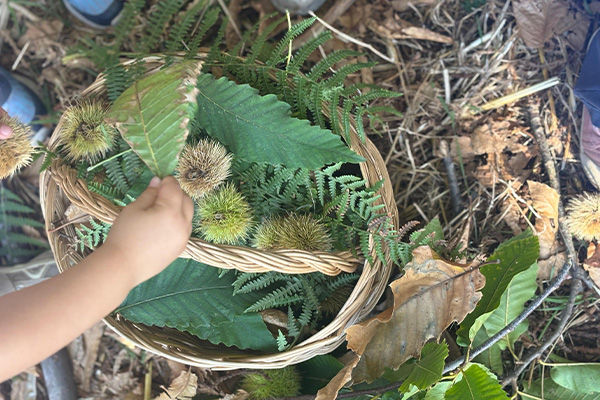
Forest School
At Pátio da Inês, our students benefit from Forest School approach, which aims at the holistic development of the child, providing a space for practical experimentation for children to boost their skills and abilities, such as: confidence, creativity, risk management and autonomy.
In the forest, the child learns to manage the use of tools, build shelters and explore natural spaces. In addition to all the learning acquired, principles of mutual help, respect for others and the environment, resilience and problem solving are developed. These activities also help to improve physical endurance and strengthen the immune system.

Art Project
Art plays a crucial role in learning by drawing on a multiple of intelligences and promoting a particular way of observing the world and communicating it to the outside world.
Creativity (individual or collaborative), cultural interest, and expression/communication challenge and complement the assimilation of scientific, technological, linguistic, and worldly knowledge that education—from nursery to the end of primary school—has the mission of providing.
Art is therefore integrated into the daily learning of our students and is a focal point of our Educational Project—from dance to music, arts, and dramatic expression.

Health Education
The Health Promotion and Education Project (PES) are transversal to all levels of education (from Early Childhood Education to Primary School). It is developed at different levels in an integrated way with the curriculum, according to the essential content/objectives/goals/learning to be worked on at each moment, and in articulation with the subjects of Psychomotricity/Physical Education, Knowledge of the Environment/Environmental Study and Citizenship.
In a school context, health education consists of equipping students with the knowledge, attitudes, and values that help them make responsible choices and take conscious and informed decisions, appropriate to their health and physical, social, and mental well-being, as well as the health of those around them, giving them an active role.
This project addresses topics such as “Nutrition Education and Physical Activity,” “Affections and Sex Education,” and “Mental Health and Violence Prevention.”

Experimental Sciences
Children question the world around them and always want to know more. It is up to adults to create the conditions and places for children to formulate hypotheses and find solutions to their questions.
At Escola Pátio da Inês, this place exists: a place with its own accessible materials that allows them to awaken and satisfy their scientific curiosity.
The activities to be developed are proposed based on criteria from the Environmental Studies programme, as well as the social context and experiences of the children.
Eco-school Programme
Eco-Schools is an international programme of the Environmental Education Foundation that aims to encourage action and recognise the quality work carried out by schools in the field of Environmental Education/Education for Sustainable Development.
Developed in Portugal since 1996, it is coordinated nationally by the Blue Flag Association of Europe (ABAE) and, in each school, by a responsible teacher.
The Eco-Schools Programme provides methodology, training, teaching materials, support and framework for the work developed by the school, and is based on an Action Plan (included in the School’s Annual Project). The “Green Flag” recently obtained by the school is an award from the program granted for the methodology and good practices presented.

To Be Healthy
Project To Be developed and launched the To Be Healthy initiative, aiming to make its schools a reference in promoting health and well-being within educational communities.
In the area of nutrition, To Be Healthy focuses on fostering healthier and more sustainable dietary habits and practices. It is implemented in partnership with nutritionist Mariana Bessa from Nutrir – Food and Nutrition Consultancy, and includes:
- Varied, balanced, and complete menus with natural foods and essential nutrients, including a daily ovo-lacto-vegetarian option;
- Training for school staff (kitchen personnel, for refining menu preparation methods, and teachers, who will continue the food education project with students);
- Nutritional education activities with students;
- Workshops with families;
- Monitoring and reducing food waste.
The To Be Healthy menus prioritise offering fresh fruits and vegetables, reducing meat consumption, and minimising the use of refined sugars and salt.
To Be Healthy also promotes regular physical activity and sports as part of the school routine, recognising their benefits and contributing to students’ physical, emotional, social, and cognitive development.
To Be schools offer numerous curricular and extracurricular activities related to physical activity, and students engage in projects focused on health education and healthy lifestyle habits. Inter-school initiatives are organised (such as tournaments, field trips, and outings), both at school and in the community, along with activities that involve family participation (walks, projects).

School Library
The School Library at Pátio da Inês is an open and flexible space that encourages reading.
An underlying element in the acquisition of new learning. And it is also a place where various activities take place that contribute to the development of transversal skills and, in specific cases, essential skills.
Based on the 21|23 School+ plan, the aim is for the School Library to promote improved reading comprehension and encourage the pleasure of reading, not only in formal learning contexts but also in other socialisation, digital, non-formal and informal contexts.

Citizenship Education
Children question the world around them and always want to know more. It is up to adults to create the conditions and places for children to formulate hypotheses and find solutions to their questions.
At Escola Pátio da Inês, this place exists: a place with its own accessible materials that allows them to awaken and satisfy their scientific curiosity.
The activities to be developed are proposed based on criteria from the Environmental Studies programme, as well as the social context and experiences of the children.
INGLÊS INTEGRADO E Certificação CAMBRIDGE
Multilingual skills are recognised as essential skills, which must be developed early to ensure the success of lifelong learning.
In the current context of mobility, internationalisation and interculturality, we believe that learning English is an indispensable and facilitating tool in adapting to a globalised world.
Pátio da Inês is finalising its application to become a Cambridge Educational Partner, with the aim of implementing an integrated English programme that involves the whole school community. The School will also operate as a Cambridge Preparation Centre for English Qualifications, enabling pupils to sit Cambridge exams on site.
We invest in early development of communicative proficiency in English. The programme will be delivered by specialist teams of teachers and teaching assistants and will include:
- Bilingual learning by linguistic immersion — Portuguese and English from Nursery
- English classes from preschool
- CLIL Approach (Content and Language Integrated Learning) from preschool
- English as a subject with the Cambridge curriculum (Key Stage 1/Primary)
- Cambridge certification — Young Learners Exams (Primary)

To Be Parent
Project To Be encourages, in its schools, a family and affective environment, with the participation of parents as central elements of educational processes, valuing openness and cooperation within the school community.
In compliance with the To Be values, there will be organised information sessions open to families or thematic sessions on parental education.
Pátio da Inês parents are encouraged to participate as speakers in lectures and webinars related to topics in their professional area of interest.
Social Impact
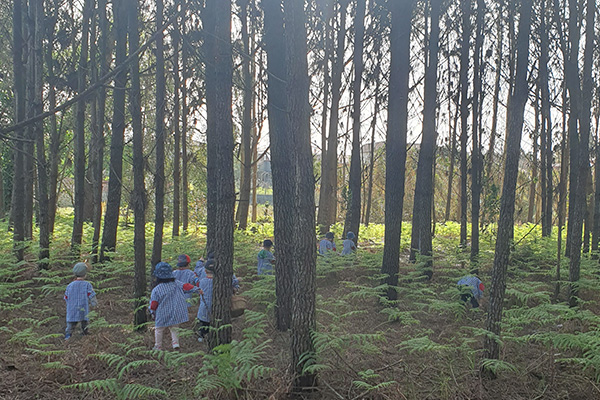
Our students participate in projects with an effective social impact, which respects their motivation and interests, and involves them in a meaningful and memorable way in dynamic and experiential learning.
We view the school as an active agent of change within the community, educating students for lifelong citizenship and involving families in impactful actions.
Every two academic years, a central To Be theme is identified to develop a large-scale project across all To Be educational communities.
BE BLUE PROJECT
The BE BLUE Project – For a Bluer Ocean and an always Green Planet mobilised the educational communities of To Be Schools for the cause of protecting the Ocean (see the Be Blue Documentary).
Numerous scientific-pedagogical, field, and artistic activities were organised within the schools and in public spaces of the community, in partnership with individuals and organisations connected to marine conservation.
Be Blue encouraged the active participation of students, educational communities, and local communities from all To Be Schools.
BE KIND PROJECT
The BE KIND Project – A Bridge Between Generations raised awareness in the To Be School communities about the importance of intergenerational connections in building a more inclusive and compassionate society.
Its main purpose was to mobilise students, educational communities, and local communities to develop initiatives that promote intergenerational meeting and sharing.
To Be Schools collaborated with various local community organisations to organise intergenerational dynamics. Grandparents from the To Be families were regular guests at the schools, sharing memories, knowledge, and experiences (watch the Vila Be Kind Be Happy film).

Reading Monitoring Programme
To strengthen this competence in Primary School pupils, we have implemented the Reading Monitoring Programme, which makes use of the digital tools Microsoft Reading Progress and Microsoft Reading Coach.
This programme enables the assessment and development of each pupil’s reading skills in an individualised and personalised way, allows for the early identification of difficulties, supports the definition of targeted intervention and practice strategies, and ensures continuous monitoring throughout the academic year and across the stage of schooling.
It complements the current reading assessment and monitoring practices used by our class teachers and reinforces the commitment of Colégios To Be to a rigorous, high-quality education.
Talk With Us
Discover the educational project of Escola Pátio da Inês and ensure a complete and individualized learning and development experience.